New year 2026

New year 2026

Sunday, 20 March 2022

SALONE DEL MOBILE 2022: ALL GATHER UP!


The press presentation conference for the 60th edition of the Salone del Mobile.Milano (in central image above), opened to the entire design community last week. Chaired by Luca Dondoni and opened by the Mayor of Milan, Beppe Sala, was the harbinger of many new things, discussed by Maria Porro, President of the Salone del Mobile.Milano and the protagonists of the Salone, scheduled for this June 2022, from the 7th to the 12th of that month. 

Open, humanitarian, more aware than ever of the issues and the challenges of the Here & Now, inclusive of the whole Design industry  and eventually concluding to Society apart from just being THE major trade fair of the sector, Salone came a long way, since last year and every other year after its inauguration 60 years ago. Last year was already the beginning of many great things with the introduction of Supersalone and the launch of the digital fair, next to the physical exhibition we are all familiar with. A huge success of unprecedented caliber, Supersalone alone generated about 5 billion euro, with an overall turnover for the whole furnishing and lighting sector macrosystem of 26 billion euro in 2021-(which puts Italy in the 1st place of EU exports again)- proving once more that the end of important fairs is far from happening any time soon, nevertheless their success depends on the multiple ways used to re-invent those fairs and adjust them to the needs of every era.  

“Politics have to take a step back, exhibitions similar to the Salone are more important than limited and stale political rivalries. In Italy and more specifically in Milan we acknowledged the need to continue working with the same insatiable desire for creation, the same work ethics and live for this incredible Momentum”. 

Stefano Bolognini, Councilor for Social Policies, Municipality of Milan, Lombardy, IT

From the confirmation of a live event, packed with brands giving free rein to their creative powers of expression, to the “wow” worlds, the theatre, the stands, both simple and complex, but all equally brilliant, and the biennials - EuroCucina with FTK – Technology for the Future and the International Bathroom Exhibition - which accompany the annual events: the Salone Internazionale del Mobile, the International Furnishing Accessories Exhibition, Workplace3.0, S.Project and SaloneSatellite. 

From two great installations – one in the city and the other at the fairgrounds – dedicated respectively to celebrating the key values of the Salone and the issue of sustainability, ecological transition and the future of living with respect for the planet, which will be unveiled by  Davide Rampello and by Mario Cucinella, to the creative partnership with Emiliano Ponzi, the world-famous illustrator and creator of six illustrations (2 shortcuts of the Ponzi universe 4 Salone just bellow), forming the captivating communication campaign for this edition of the Salone.   


“Sustainability, reducing the environmental footprint, use appropriated materials (mango cellulose, fishtail-based-fibre) among others, introduce accessibility for instance  to visitors with visual impairment such as Braille in every public inscription or signage of goods inside the exhibition area, are only a few things we are working on in order to align Salone with services provision for all visitors, exhibitors, operators, traders, press officers.” 

Maria Porro, President of the Salone del Mobile.Milano 

In pictures bellow: Architect Mario Cucinella explains his visions of planetary transition and the future interconnection of City and Housing through the installation project Design with Nature. A shortcut of the inductive visual narrative demonstrating 11 Values of the Salone-11 Films made especially for the Salone 60th Edition by its artistic director Davide Rampello and 10 other prominent film-makers/artists. 


On the topic of Salone Satellite, an invaluable springboard, discussed by renown designers and old participants of the Satellite, Cristina Celestino (in picture bellow) and Sebastian Herkner. As an institution Salone Satellite continues to promote the work of young designers under 30 years old, as much as the collective production of design schools and universities worldwide, through the spectrum of Sustainability=Respect 2 Our Future Selves. 


Designing sustainability, celebrating beauty, declaring Opportunities and not Opportunism, triggering the Diplomacy of (creative) People all around the world, Salone is waiting for YOU out there, your physical or digital presence, contributing with the best of your abilities: your inner vision for Peace and ethical, quality business and commerce.  

A last Salone quote back in 2016, our 2nd year there, directly from those endless Marathon-like fairgrounds at the Fiera Milano- Rho premises (NOT for the fainthearted):  

“People ask us (the Italians), how did we do it, how did we make it back then? The launch of a design week and a furniture fair 60 years ago is not the point. The Point is: keep going, keep walking and try to offer the Very Best you Can Produce & Create, year after year, against all odds.” 

Salone will be waiting for you on these screens OR in Milan OR at both sites. 

Stay tuned! #insalonewetrust  #gatherings  #Issalonestrongerthanus 

A4D-D4A πŸ’™πŸ’šπŸ™Œ

Monday, 7 March 2022

CAN WE, SHALL WE, WANT WE>>BUY MORE & HOW? DESIGN THE FUTURE OF SALES, (powered by Globant + Tech UK).


In photo above: Delivery drone by Roland Berger

How can we program and design sales in the digital ecosystem of the future? In the currently saturated West-meets-East commercial environment online/offline and a War of the Worlds when it comes to market control, the future of sales needs to be readdressed and  re-mapped under new standards. Digital reality bites, with the consumer hammered by lack of personalization and fragmentation of services leading to irrelevant product proposals and a repetitive approach in marketing far from precision techniques liaising client per product. Smart tech intergration and adopting digital reinvention as a model is imperative for sales survival. 

Operations, governance, resources, training, consolidation of a seamless customer omnichannel experience: should or can companies invest? Hyper-personalization and GDPR: are they walking hand in hand? Can customer satisfaction improve retention through the use of NFTs/Metaverse as well? 

“The important thing is not Technology in a standalone way: the choice of implemented tools is the point, prioritizing a direct, custom-made experience with the consumer”… 

Pablo Monge, Global Head of Digital Sales at Globant

Simplifying this highly complex ecosystem can unlock the potential of a blended online and offline experience in different industries like energy, telecoms, travel & hospitality plus financial services, among others: connecting data in a transformative way, maximizing their value with an extra effort  to better  communicate the end product to the receiver/customer is one of the essential challenges to face, especially in sectors like the automobile industry, ravaged by recession complications and an old-school sales approach.  

“Really Know-Your-Customer through integrated technology: For instance book a TestDrive using Data-Enabled Services before buying a new vehicle, adopted to your own needs and preferences.  Technology is the Enabler of hyper-personalized experiences through a unified 360 data model.” 

Dean Parker, Design Strategist at Clobant. 

The sales force suite can make use of data from Sales, Customer Services, Marketing and Business functions including Social Media platforms. If you need to organize your next electric car purchase in accordance with Colour & Trim from the print archive of your favourite modernist designer, a Holter monitor app for your suffering grandmother and a mini Metaverse studio with protected gaming-language learning Bank for your offspring, that should n’t be a problem anymore, (provided that along with purchase you also join a reward NFTs scheme: a Test-Drive simulator app for your 16yr old daughter if you live in the U.S, including a map of Recharge stations around your locality or county). 

Compliance with current GDPR regulations across countries is fundamental though. Consent management layers in exchange of every bit of data provided by the customer, is only a basic prerequisite for the whole experience to become sustainable. Even in major physical, global events like a football tournament, their augmented reality interpretation and transformation in multiplex digital environments like the Metaverse, demands an alignment of several technologies for ticketing, copyright protection and content distribution.  

Areas like energy, tourism and finance have been severely wounded by the post-pandemic crisis and the general transformation of the multi-leveled western markets structure to an homogenous sphere of activity, as it was originally introduced by FinTech startups and Crypto. Next step: buy what you need, when you need it, if you need it and make it uniquely specific to your profile only. The era of mass production comes almost to an end. 

Follow TechUK actions and events here. 

All the Best + Bloody More 

A4D-D4AπŸ’™πŸ’šπŸ™Œ  

Wednesday, 23 February 2022

BACK TO NETWORK SLICING: A GAME CHANGER (5G GUARANTEED). Powered by OMDIA & Cienna.


Network slicing design is back in A4D-D4A, with recent and more explicit info about the technology and how this can confederate an investment of high importance in 5G and beyond. All the information bellow can be revised and found in OMDIA social media and resources

The ways you can exploit the technology into your business model in the future is a key element for this short memorandum, aiming at the explicative yet simple report of the specific architecture, a crucial point from now on and until 2030 for smart cities, public transport, smart agriculture, haptic (tactile) internet, smart logistics, intelligent health systems and diagnostics, industrial robotics, shipping systems and cranes.  

A network slicing consists of a logical network that provides specific network capabilities and network characteristics to serve a defined business purpose of a customer. It also allows multiple virtual networks to be created on top of a common shared physical infrastructure and it extends across multiple domains, including: 1. RAN (Radio Access Network) 2.Transport 3.Core infrastructures. Thus said, you can expect a complete set of transformative improvements at business in areas such as latency, security, reliability, quicker customizations (a tailored, consumer related system exceptionally useful in sectors like gaming and games design) and easy adjustments when it comes to external tools and alignments with other IT implementations. The ability of the technology to include scalable business models in its portfolio enterprisingly, makes it an economic venture that creates high potential at wholesales ever so remarkably.  

The “culture of layers” the one we were used to the previous decades, changes to a whole different model where it allows E2E (Exchange 2 Exchange) interactions such as monitoring IoT devices or making Metaverse a more enjoyable and realistic experience through haptic internet: a common practice and not just an idea for the near future. Open, modular automation helps operators accelerate and simplify every stage of their 5G journey (federation for complete network and service inventory across multiple domains, E2E orchestration of dynamic services across RAN, transport & core, analytics-driven assurance to monitor services in real-time, automation of each slice lifecycle in order to cope with new digital services and monetize with customers, internal and multilevel service-level agreements).  

Synchronization is quintessential though as it is mentioned in one of our previous posts regarding Network slicing and 5G integration and implementation.   

 “Most mobile and wholesale network operators are taking a phased approach to their 5G network and services rollout, and with good reason. Besides having to evaluate the different business strategies and revenue-generating opportunities, 5G also involves numerous new technologies and standards that continue to mature. This can lead to significant operational complexity, not only to deliver the required coverage and performance, but to optimize the coexistence with 4G (and previous wireless generations), which will be required for many years to come.”….”In such an intricate scenario of many moving parts, mobile network infrastructure must also continuously evolve to support new features, standards, architectures, and end-user services. Having worked with many of the world’s largest Mobile Network Operators (MNOs) in their 4G to 5G journey and supporting backhaul to over 75 percent of all towers in the U.S., it is evident that for mobile and wholesale network operators to be successful, their 5G network architectures must be based on the Adaptive Network™ approach and embrace the key tenets of being open, scalable, and automated….” 

An extract from: White paper, 5G Success Using the Adaptive Network Approach, delivered by Cienna 

Today, end-users want to order services on demand using self-service capabilities, and they expect flawless performance. As a result, Communications Service Providers (CSPs) are under tremendous pressure to develop and deliver services much more quickly, with exceptional quality and at the lowest possible cost. Meeting these requirements is no small feat, especially when customers often ascribe more value to cloud applications, mobile devices, and media-rich content than they do to connectivity. The challenges to face though continue to occupy the tech world as shortlisted concerns to tackle quickly and efficiently as one company or public domain possible can: the ability to orchestrate service/slices across an admin system that actually works, updating and modernizing Operational Systems, adoptively visualizing services like network slices in realtime are some of the few to come.  In the meantime 5G and 6G are the only networks to guarantee infrastructures of inclusion for population majority, including seniors, low incomes and limited mobility groups, therefore their immense importance for each village, city, territory and the continent as a whole.   

NEXT ON A4D-D4A: More on the Future of Sales (retail and NFTs includedπŸ˜‰).  

All the Very Best & More 

A4D-D4AπŸ’™πŸ’šπŸ™Œ

Tuesday, 1 February 2022

ALL 4 CHANGE: Can A shift in Fashion still be Possible? (powered by "The Impact of Covid-19 on Women Workers in the Bangladesh Garment Industry‟ research report by the University of Aberdeen, Traidcraft Exchange UK, & Modern Slavery and Human Rights PEC).


Fashion is changing, along with many other things in design. Believe it or not, it does. The state of the fashion industry globally, is starting not only to imply the need for modifications of all kinds but to introduce the necessary tools (some of theme already there for more than a decade), to make fashion a (more) sustainable place, a fairer business for the humans and the planet. The rhythm might be still slow but steady and decisive towards that direction, the procedure can be proved a conflicting one, even painful but absolutely inevitable in order to progress inside the industry, macro-economically and ethically. Bangladesh is one of the epicenters of the global ready-made garment (RMG) industry: being  the mainstay of the Bangladesh economy, the sector accounts for 85% of export earnings, about 20% of GDP, and directly employs about four million workers with more than 12 million workers dependent on the sector.  

The impact of Covid-19 and the cancellations of orders by retailers, many of which are based in the UK or have operations in the UK market, have led to factory closures and job losses, leaving around 2.8 million workers facing poverty and hunger. More recent reports show that Covid-19 is having an ongoing impact on the industry and, more specifically, on the factory workers. Beyond the disruption caused by buyers cancelling orders and not paying for orders in process, the industry was disrupted by a lockdown, the costs of Covid-19 mitigation measures in the factories, and buyers demanding discounts when they started to place new orders. 

The disruptions from Covid-19 exacerbated interrelated vulnerabilities in economic security, job security, food security, housing security and health and wellbeing, resulting in women workers struggling to support themselves and their families. These serious disruptions and devastating impacts on workers were exacerbated and, in some cases, directly caused by retailers and brands selling into the UK and other markets in the Global North.  

The Covid-19 related disruption of the RMG has had a negative impact on workforce and owners, but the most negative impact has been on female workers.  Physical violence, disrespect, indifference to essential or primary human needs (i.e toilet time), penalties for those supporting demonstrators) et al. Pregnancy is reported as “punished” with dismissal and long-term contractors are threatened because of their established/locked work rights to compensation. Unions are hesitant to seriously intervene as a safety net for those in danger and fellow workers are terrorized to be fired in case of openly supporting colleagues. Lack of sleep, malnutrition, anxiety and despite the forced sanitary measures induced for protection against Covid-19 (masks, hand sanitizing etc), the overall conditions or work plus the level of the employees general well-being continue to be rather appalling. Gender discrimination, harassment and abuse are additional pivotal issues regarding the mal-exploitation of female workers especially, a double-ended blade both inside their home and also at their work environment.   

As the current condition and status of women and girls in employment in Bangladesh remains poor, Bangladesh is rated as one of the ten worst countries on the Trade Union Confederation’s Global Rights Index. Bangladesh has signed up to the international frameworks for promoting gender equality including in employment. Although the Constitution mandates gender equality, this does not apply in the private sector, and there is no law promoting gender equality or prohibiting gender discrimination in employment.   

Bangladesh does not seem to comply with international Labour laws and regulations, just yet though. Compliance auditors were least likely to say they had audited for trade union recognition; 40% did not check for this. In the interviews with representatives of trade unions, the international development agencies and international and local NGOs, concerns were frequently raised about the negative attitudes of owners to trade unions and their reluctance to let workers exercise their limited rights under the law.

Pilars 4 Change: New Framework of Regulations in the EU, UK and the West, Independent Watchdog Institutions,  proper sourcing, diplomacy, social pressure, media engagement.  

Chief investigator of this project, Muhammad  Azizul Islam, PhD, Professor in Sustainability Accounting & Transparency at the University of Aberdeen Business School, took the time to kindly answer the following questions with the opportunity of the report finally going public last week (for the full published document please click here).  

all4design-design4all: Fast fashion still continues as greenwashing does evidently, what more needs to be done in order for the specific part of the industry to be seriously regulated?  

Prof. Muhammed Azizul Islam: In our report, we have a few recommendations such as an independent fashion watchdog. Based on our findings, we can reflect on the UK Modern Slavery Act and argue that such regulation gives scope for greenwashing via voluntary disclosures. Mandatory disclosure requirements with mandatory independent audit with the penalty for human rights negligence within the supply chain, would be helpful to reduce slavery.    

A4D-D4A: Underprivileged youth and their access to the fashion industry: is it a possible career path for young people without substantial means not only in countries like Bangladesh but generally in similar countries where outsourcing in garment production is very expanded?  

Prof. M.A.Islam: Education is the most important factor for any good career path. Right now, the majority of workers in the RMG industry in Bangladesh are women who are young, poorly educated and from rural areas with few alternative employment options. One may need to realize that if someone is educated and aware of their rights as human beings, employers cannot offer them low wages (or wages lower than the minimum legal limit). Poorly educated people are the most vulnerable to exploitation in this world. In our study, we found some instances of young women employed in the factories during Covid-19, and there was a high risk of exploitation as young girls were paid a low salary (even below minimum wage). If girls were well educated, they could choose their own destiny, but most of the poorly educated girls in Bangladesh and other similar countries do not have a voice against exploitation.  

A4D-D4A: How technology (apps, platforms, digital tools) can help educate fashion workers in terms of developing their skills but also getting awareness about their rights?  

Prof. M.A.Islam: Our research did not focus on the technology aspect specifically. But my argument is technology is less likely to resolve or reduce exploitation if brands‟ own unethical behavior cannot be controlled by technology.     

A4D-D4A: Do you feel that the current curriculum in fashion institutes and universities is focusing enough on eco-conscious, ethical and sustainable fashion, in terms of courses, seminars and practices?  

Prof. M.A.IslamThis is a really good question. Coming from Business School, I would say the way CSR (Corporate Social Responsibility) and sustainability education are heading is not helpful in creating change. We need education that challenges the current practices, need to question taken for granted approach. Please have a look at this short article under the link (education material  for aged 14-19), in which I raise concern over business schools‟ lack of focus: Tackling modern slavery: a sustainability accounting perspective- Futurum  

A4D-D4A: Do you think that circular fashion (upcycling) in studios, haute couture and factories can possibly create a new financial ecosystem in the future for the fashion and accessories industry-at-large?  

Prof. M.A.Islam: Yes, circular fashion is important and should encourage people to use fewer clothes, reuse clothes. One must think of why we need one another—this would help our earth and climate. This is my future research agenda!  

Many thanks to Professor Muhammad Azizul Islam, PhD, for his intervention.

                              ----------------------

All citations from the report in the article are attributed to: Islam M. A., Abbott, P., Haque, S., Gooch, F. & Akhter, S. (2022),„The Impact of Covid-19 on Women Workers in the Bangladesh Garment Industry‟, Research Report, January 2022,The University of Aberdeen and the Modern Slavery and Human Rights Policy and Evidence Centre (Modern Slavery PEC), UK. This is a report from the project entitled Toward the Development of Post Covid-19 Gender Policy Measures to End Modern Slavery and Exploitation in the Bangladeshi Garment Sector, the Modern Slavery and Human Rights Policy and Evidence Centre (Modern Slavery PEC) research project, funded by the UK Arts and Humanities Research Council (AHRC). The research was carried out by Muhammed Azizul Islam, Pamela Abbott, Shamima Haque, Fiona Gooch and Salma Akhter.  

*The views expressed in this report are those of the authors and not necessarily of the Modern Slavery PEC, the Court of the University of Aberdeen, Traidcraft Exchange or the Arts and Humanities Research Council. This project was funded through the Modern Slavery PEC open call for proposals.   

The Modern Slavery and Human Rights Policy and Evidence Centre was created by the investment of public funding to enhance understanding of modern slavery and transform the effectiveness of law and policies designed to overcome it. With high quality research it commissions at its heart, the Centre brings together academics, policymakers, businesses, civil society, survivors and the public on a scale not seen before in the UK to collaborate on solving this global challenge. The Centre is a consortium of six academic organizations led by the Bingham Centre for the Rule of Law and is funded by the Art and Humanities Research Council on behalf of UK Research and Innovation (UKRI).  

#All4FashionRevolution  

A4D-D4AπŸ’šπŸ’™πŸ™Œ 


Sunday, 16 January 2022

ENZO MARI, (1932-2021): The insatiable quest for (real) design and beyond.


Multiple categorizations in archives and files related to Enzo Mari and his works as a designer/ maker/ intellectual/ revolutionary, fail really to describe his “style” or let’s better say to place him on a specific rank in design history. His radical aspirations (inside the Nuove Tendenze movement back in 1963), his off-key start in fine arts and book binding, his beliefs in the New Age idealism of the 70’s (published in his own private manifesto, the legendary “Funzione della ricerca estetica” in 1970), his engagement to a personalized process when it comes to mass production (illustrated in his “Tecnica Povera”- inspired furniture in 1974), his warnings about over-industrialization, his disappointment about progressive political powers turned into a toxic status quo, his criticism on the 90’s design glamorama, his continuous faith to a system of values of caring/amend/curate –made him an anticonformist figure among the constellation of pioneering design superheroes in and out of Italy, his country of birth. 

A child and a teacher, a rebel and a restorer, a maker and a technocrat, a thinker and a maker, Mari’s legacy goes far beyond design and it contributes to a mindset or a system of politics of thought, which is very powerfully influential on the millennials’ readiness  for a change, especially during the pandemic era. His positioning in creative self-doubt when it comes to the evolution of his work throughout the years, from his very first design of a ingenious wooden toy of 16 animals piling up, made for Danese in 1957 to his most recent works like the citrus juicer Titanic for Alessi and his lighting designs for Artemide, Mari is the last of the great Masters of design, one that incarnates the indefinite questioning of his proper abilities, pushing the boundaries even when his at his safest in terms of acceptance and recognition. 

With a healthy distance from the over-playfulness-per se of the Memphis movement, reluctant and worried to the massive use of plastic established by the Futurists, inciting Utilitarian modernism but in limited mass production high-grade steel kitchen utensils only for them to be able to last the maximum period of time, embracing wood and its remains to up-cycle furniture parts in an advanced eco-friendly mode, understanding the need of a universal political movement, one that resists the cruel ambitions of political lobbyists, Mari resumed his incredibly good design as a entirely independent spirit, non-aligned  with any league or system, always truthful to his own, inner voice, always ahead of its era. Alberto Alessi’s quote on Mari: “I am grateful that Enzo Mari (ever) existed and continued to work fervently, non-stop, with courageous and uncompromising tenancy in a world that design is always under the threat to be dominated by pure marketing”. 

Thank you 4 All Enzo Mari. Float away into the galaxy, kept by the company of our warmest thoughts. 

A4D-D4AπŸ’™πŸ’šπŸ™Œ

Sunday, 26 December 2021

NEWS AND UPDATES JUST BEFORE THE END OF THE YEAR…(WELCOME 2022).


In central image above: Pantone Color of the Year 2022: Very PeriπŸ’œ

Money is not the issue anymore, Self-Realization is. Welcome 2022. 

Just before this year comes to an end, a round of applause for the last updates regarding tech, design et al., but also interesting facts and figures  we saved for last…Enjoy and come back for more next year for sure! 

-World Mobile, who recently announced their plans to make low-cost, high-quality internet access available to Zanzibaris, has signed a partnership with the Ministry of Education and Vocational Training in Zanzibar to provide free, unlimited internet to schools across the region. The target is to connect all schools in the region by the end of 2022. In addition to connectivity, World Mobile has installed some laptops for teachers and students. Roll out will be achieved through a close collaboration between World Mobile and the Ministry of Education and Vocational Training to install solar telco and power equipment efficiently in schools. Providing access at schools will also enable World Mobile to supply connectivity to the local areas around them, boosting the local economies. Revenues generated from this will benefit the schools directly as they become node operators on the World Mobile network. 

-Data linkage provides insight, informs policy change, and helps answer society’s most important questions through increasing the utility of data. Within the context of innovation and modernization in public services, Socitm, GeoPlace and Barnsley Metropolitan Borough Council utilize Unique Property Reference Numbers (UPRNs) as those last can provide a wealth of insight and enablement for local authority decision making and projects. Socitm is supporting the ethical use of data and data insights effectively to make informed decisions and support ethical change as part of wider placebased post Covid recovery. UPRNs can facilitate data linking within a local authority context and this can be used to create a rich picture of intelligence for analytical and project needs.  

-Another EU member decides to seriously test crypto: No other than Estonia, Estonian central bank Eesti Pank and Guardtime research project confirms role for digital bill money systems in CBDC deployment KSI Cash per transaction energy use is just 70 Β΅Wh (micro-Watt hours) compared to 0.1 Wh for Visa and 1 MWh for Bitcoin.Blockchain technology can play a key role in the development of Central Bank Digital Currency (CBDC) platforms worldwide, a joint research project by Estonian Central Bank Eesti Pank and leading European deep tech company Guardtime has found (please see the attached press release). The study set out to investigate the technological and operational frontiers of blockchain technology and its use in the context of CBDCs using KSI Cash, a digital currency technology based on the KSI Blockchain. 

Testing confirmed that digital bill-based money systems are linearly scalable and highly efficient delivering end-to-end payment times of 0.6 seconds based on speeds of up to two million bill transactions per second. Crucially it delivered a much smaller carbon footprint and lower energy use than current instant payments platforms – per transaction energy was just 70 Β΅Wh (micro-Watt -hour),compared with 0.1 Wh (Watt hour) for Visa and 1 MWh 

(Megawatt hour) for Bitcoin (1 Megawatt hour is one trillion micro-Watt hours). The summary report written by Rainer Olt and Tiit Meidla of Eesti Pank and Luukas Ilves and Jamie Steiner of Guardtime says:  “The CBDC platform we deployed proved to perform well. The system was tested at speeds of up to two million bill transactions per second, where it operated with faster transaction times, lower energy use, and a smaller carbon footprint than current instant payment platforms.” 

-The CCPC is launching a full investigation into Synch Payments to determine if it lessens competition in Ireland. The launch of a proposed payments app by four major banks in Ireland has hit another stumbling block, with the country’s competition authority launching an in-depth investigation into the joint venture. 

In January, AIB, Bank of Ireland, Permanent TSB and KBC Ireland alerted the Competition and Consumer Protection Commission (CCPC) of their intention to create a digital payments service to compete with the likes of Revolut (which has more than 1m Irish customers) and N26. Following a preliminary assessment, the CCPC said that it found the notification to be invalid because it was unable to gauge the scope of the Irish banks’ plans. 

Last month, the Irish Times reported that Synch Payments had secured an additional €5m to fund the venture, led by AIB and Bank of Ireland buying up more than €4m in shares. Permanent TSB bought €855,000 in stock while KBC, which will soon exit the Irish market, bought only €8,500. This was on top of an initial capital raise of €5.9m that was reported earlier in the year. 

*Growing digital banks such as the UK’s Revolut and Berlin-based N26 pose a significant threat to the market share of traditional banks because of their easy-to-use smartphone applications and popularity with younger users. Earlier today (9 December), UK neobank Monzo was valued at $4.5bn after a fresh funding round that saw the company raise $500m. 

-Quant technology provider SigTech has announced that Revelio Labs, an industry leader in workforce intelligence, is the first client for its new Data Showroom service, a platform that revolutionizes the way data owners sell their data reducing the sales cycle from months to weeks.The SigTech Data Showroom, which launched in November this year, allows users to validate the value of alternative data within days rather than months by providing preloaded, mapped, and harmonized data, as well as signal code examples and backtesting building blocks. 

The Data Showroom provides data owners with more transparency on how customers are using their data, making it easier to engage prospective new clients and to convert trial users into paying customers. 

Revelio Labs’ team of data scientists, economists and engineers deliver industry leading workforce analytics and data to support strategic planning for companies looking to compare their own data to competitors. Most workforce data, unlike financial data, lacks the standardization necessary to develop sophisticated trading models. 

-Today’s apparent exchange between U.S. congressmen and crypto executives has been surprisingly productive, civil, and open-minded. This is big for web3. At stake in the House of Financial Services Committee hearing during the previous weeks:  the future of digital assets, (meaning  NFTs, stablecoins, and their  availability in the near future. Investment on those values seem to be entirely relevant and not the digital-chimeras-type-of -discussion during previous years, especially with the USA struggling to find an adequate position for its size in digital growth, in the comprehensive list of the big country players in crypto. The intentions are clear from inside the White House and beyond as well, that the U.S Dollar is there to coexist with its crypto-offspring in the near future. 

-Next Steps in AI: The Critical Role of Research and Innovation in realizing the full potential of AI, including training the next generation of researchers, supporting talent, and the importance of fundamental AI research in AI innovation became apparent during Covid’s first wave in the UK and it evolves rapidly. At present time UK is ahead in the amount of startups in AI in comparison with the USA:  training the public and the work sector in AI remains a challenge, nevertheless responsible, regulated AI in order to be robust, unbiasedundiscriminating and transparent, is tailored to each domain application. 

At the core of the educational system, starting from the schools, UK acknowledges the need to get the best people and train them with AI training programs conversion aiming to master AI: not just to pick it from the shelf but make it customizable to the best use of the individual or service domain. 

Data analysis and coding are about to get re-diverted not just to how-to-use AI but how to INVENT AI. Academia and industry have a foot in both camps as good AI is getting made always by diverse teams. Trust is another issue since AI tends to be appreciated but not judged as an irreplaceable technology of high importance, a pervasive locomotive in economy across all sectors. Slowed down or hammered by regulation? AI is not scared of regulation in the UK as all startups are very accessible, but all investors need to do is asking or getting ASKED TO INVEST.  

Key people in the AI field:  

Tim Cook, Deputy Head, The Office for AI 

Kathryn Magnay, Deputy Director - Cross-Council Programs, EPSRC 

Aldo Faisal, Professor in AI & Neuroscience & Founding Director, Centre in AI for Healthcare, Imperial College London 

-Whats new in Tech? Check out some of the industry’s most trailblazing females: 

Tugce Bulut, Founder & CEO, Streetbees 

Rose Hulse, Founder & CEO, ScreenHits TV 

Sam Evans, Head of International, TechNation 

-In the search of their (digital) future:  young people and employment. Almost two-thirds of those who have lost their jobs as a result of the pandemic are under the age of 25.There is a risk that, without coordinated action, the negative economic impact of the pandemic will be long-lasting for this generation. Additionally, in a nationwide poll of 1,000 16–18-year-olds by the Institute of Coding, more than half believe the digital workforce lacks diversity. 70% of youth surveyed think the sector is run entirely by those of white, British ethnicity, and over a third think there are unequal opportunities for women. One in ten admitted they are actively discouraged from pursuing digital education and jobs due to the lack of people that represent them. While some of these opinions echo what many people in the industry may already feel, it is shocking that these are the perceptions of young people who have yet to set foot in the industry. 

Favourite Quotes of the Year (almost) Gone By:  

-“We need less information and more knowledge”. 

Elif Shafak 

-“Listen to the Quiet people, (especially at countries in turmoil)” 

Ellen Ehni 

-“New Media take time to shape and that very Form depends upon Us” 

“People Need & Deserve to Know: not only to get Informed, (about the surface of things)” 

Timothy Snyder 

-“#Infodemics is not serving as a Shield of Accurate Reporting” 

Audrey Tang 

-“Don’t devalue your Brand. Put Quality in it instead of Clickbaiting” 

Jesper Doub 

A Title 4 All for this Holiday season:  

Garden Cities of To-morrow (To-morrow: A Peaceful Path to Real Reform), by Ebenezer Howard. 

All the Best & Bloody More/A VERY un-PERI-lous Year 2022! 

A4D-D4AπŸ’™πŸ’šπŸ™Œ     


Sunday, 12 December 2021

Gatherings: Is 70’s Design Stronger than Us? (Xmas 2021 Edition).


In image above (CW): 

Room: Alessandro Mendini-My Prisons: "STANZE-Rooms: Novel living concepts", Exhibition-Triennale 2016, Milano, IT

http://www.8ea.it/en/portfolio/stanze-catalogo-mostra-xxi-triennale-milano-aprile-2016/

Lamp: Jordi Canudas, Dipping Light 

http://www.jordicanudas.com/projects/dipping-light-for-marset

Poster:  Beatles T-Shirt on Talent, Stella McCartney

https://www.stellamccartney.com/gb/en/unisex/the-beatles-get-back/get-back-t-shirt-6J0004SPW268490.html

Screen/TV/Interface/Books: LG Quantum Dot NanoCell

https://www.lg.com/uk/lgnanocell/truth.jsp

https://www.goodreads.com/book/show/16793.Stardust

https://www.jameshowe.com/books-1/2017/5/4/bunnicula

https://www.bookdepository.com/My-Fathers-Dragon-Ruth-Stiles-Gannett/9780440421214?redirected=true&utm_medium=Google&utm_campaign=Base1&utm_source=GR&utm_content=My-Fathers-Dragon&selectCurrency=EUR&w=AFFMAU9SMDG1M8A8V9RB

https://www.electa.it/en/product/enzo-mari-curated-by-hans-hulrich-obrist/

Armchair: at flea markets everywhere and 

https://www.sothebys.com/en/series/design-week-ny-2021?cmp=email_Daily_Marketing_Email_verB_N11142_N10809_N10808_N11143_Design_Week_in_New_York_06-Dec-21&utm_campaign=MARDailyEmailLIVE&utm_content=email_daily_marketing_email_b&utm_dept=20th_Century_Design&utm_medium=email&utm_source=zaius&utm_term=06-Dec-21

Power bank: https://www.zagg.com/en_eu/universal-batteries?brand=164&gclid=Cj0KCQiA2NaNBhDvARIsAEw55hhBEvPmbz_2Jio6Xi2aEWcrhCzO6uX3QUoaY7NEGGdGGaEqGX_XuPEaAoDMEALw_wcB

Music: https://www.fruugo.gr/%CF%80%CE%B9%CE%B1%CE%BD%CE%BF-%CE%BC%CE%B5-%CE%B1%CE%BD%CF%84%CE%B9%CF%87%CE%B5%CE%B9%CF%81%CE%B1-kalimba/p-53844142-108887758

Tray: https://www.sothebys.com/en/buy/paris-je-taime/_french-majolica-flower-form-handled-tray-c908

Stools: at flea markets everywhere and 

https://www.sothebys.com/en/series/design-week-ny-2021?cmp=email_Daily_Marketing_Email_verB_N11142_N10809_N10808_N11143_Design_Week_in_New_York_06-Dec-21&utm_campaign=MARDailyEmailLIVE&utm_content=email_daily_marketing_email_b&utm_dept=20th_Century_Design&utm_medium=email&utm_source=zaius&utm_term=06-Dec-21

Wine and  Condiments: 

http://www.lambouri.com/  

https://www.bostock.nz/product/apples-organic/

Spontaneous Underground. Cultural Immigration. (R-)Evolution as Heritage. Hosting and Entertaining for Friends (a crowd of 50 thousand people will do;-). Digital & Artisan. Global (Soul) Warming. A Humanity Archive.  

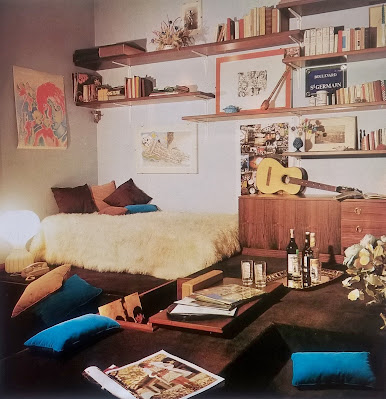
In the era of acute social media domination, it seems that the 70’s vibe transcends- still- contemporary aesthetics in design and interiors, to start with.  Aesthetics is Ethics after all, a system or set of values, defining social and political standing before creating a final image: something that only looks, works, feels good. Good design is pollinated with the 70’s legacy of Design 4 Good, firstly initiated through a psychedelic approach but ending up to the defense of Community, the sense of Belonging, a protective intention of no-harm. A notion larger than just being part of a local identity, breaking out your own Unit: the warmth of the Artisan even when design illustrates the highest tech in utilities and resources, that is a 70’s immunity to today’s turn in production.  

Escapism, losing thy self inside a personal journey of beliefs or even substances, has been heavily criticized in 70’s design, raising questions about functionality and accusations about Hoarder syndromes and consumerism. The feeling of lingering and forgetting the World and who you really are, only for the sake of becoming a part of wholesome process in terms of producing things, that storage element of the 70’s is always present even in the cashless society of the digital era. Experimental exploration in materials and formats was never about depriving design from its practical purpose but ended up to another level of creative knowledge: finding your way back to a much sought solution instead of just missing out the essential idea, in exuberant form and colour-only one element of the 70’s most people can recall.  

The 70’s apprenticeship in the development of future graphic communication, became part of an ever changing dΓ©cor and finally got built into code, marking heavily the digital dialogues of today’s reality, the IoT and soon enough the AR and Metaverse virtual ecosystems.  

Can the 70’s still produce inspiration and stock up Humanity’s archive, on the fast way into the Deep Digital? The proof is out there, all over the place in design studios and factories, and it still remains a factor of knowhow and flair conveyance to the Gen Z designers, creators and citizens.

In photo bellow: Hosting and Entertaining your Friends At Home (70’s Classic Interiors Encyclopedia).  

Season’s Greetings and a Happy Holiday 4 All!

A4D-D4AπŸ’™πŸ’šπŸ™Œ